
Why Do Teeth Turn Yellow in the First Place?
Your tooth's outer layer (the enamel) is porous at a microscopic level. Over time, pigmented molecules from coffee, tea, red wine, and certain foods work their way into those microscopic channels and settle there. This is called extrinsic staining, and it's the kind OTC products have the best shot at addressing.
Below the enamel lies the dentin, a naturally yellowish layer that makes up the bulk of your tooth. As we age, enamel thins naturally, and the dentin shows through more prominently. Additionally, certain medications, trauma, and fluoride exposure during tooth development can cause intrinsic discoloration that lives inside the tooth structure itself. No strip will touch that.
What's Actually Wrong With Whitening Strips?
The active ingredient in virtually every whitening product (drugstore or professional) is hydrogen peroxide or its cousin, carbamide peroxide. These compounds penetrate enamel and break apart the organic pigment molecules causing discoloration through an oxidation reaction.
The difference is in the concentration and the delivery method. Over-the-counter strips are limited by federal guidelines to 10% hydrogen peroxide or less, a concentration too mild to reach deeper staining in a meaningful way. Professional-grade products used in-office reach 35–40%, and take-home kits prescribed by your dentist typically run 10–22% carbamide peroxide, applied in custom-fitted trays that ensure complete, even coverage across every surface of your tooth.
Generic strips are manufactured to fit an average mouth. But your teeth aren't average. They have unique curves, spacing, and proportions. When a strip doesn't conform precisely, the gel pools in some areas and barely touches others. That's the science behind why you might get a bright front surface but still see yellower edges near your gumline.
- 3–10% hydrogen peroxide, too dilute for deep staining
- Generic fit creates uneven gel contact
- Results visible only on surface extrinsic stains
- Fades within 2–6 weeks of use
- Can cause gum irritation from gel overflow
- No professional guidance or safety monitoring
- Up to 40% in-office / 22% take-home, reaches dentin level
- Custom-fitted trays from your exact dental impression
- Addresses both extrinsic and intrinsic discoloration
- Results last 1–3 years with simple maintenance
- Gum barriers and desensitizers applied for comfort
- Monitored by your dentist throughout the process
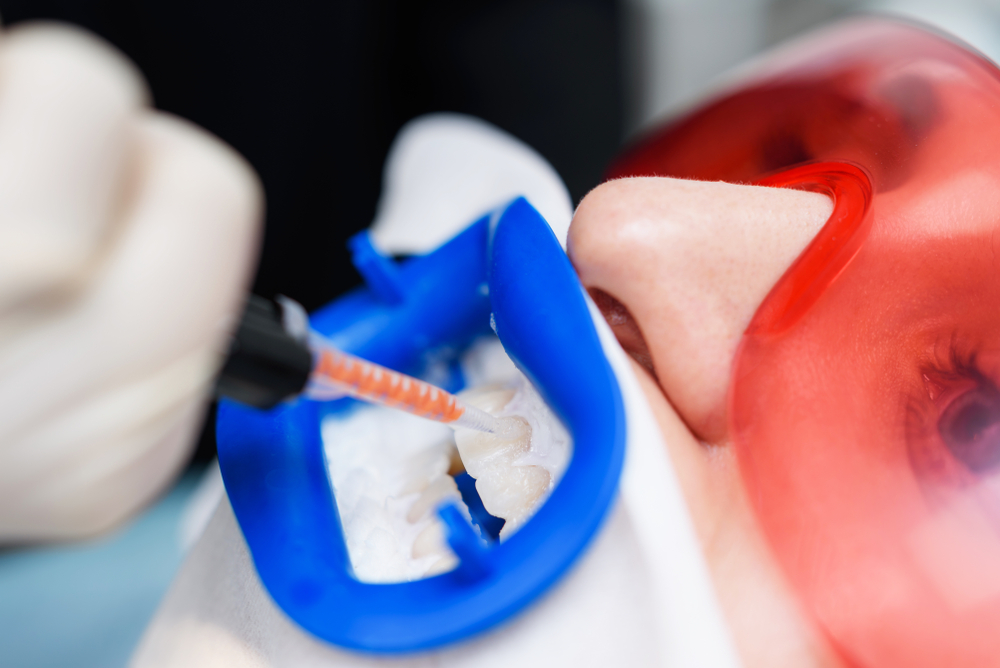
*Example photo for illustrative purposes only. Not a Toluca Advanced Dentistry patient.
Is That Purple Toothpaste Actually Whitening Your Teeth?
If you've been on TikTok in the past year or two, you've almost certainly seen a video where someone applies a vivid purple paste to their teeth, and in a satisfying before-and-after, their yellow smile transforms into something brilliantly white. The video gets millions of views. The comments explode with "I need this." And shortly after, the product sells out online.
Here's what's actually happening: purple sits opposite yellow on the color wheel. When you apply purple pigment to a yellow surface, the two hues neutralize each other visually, creating the appearance of a more neutral, whiter shade. It's the same principle makeup artists use to cancel dark undereye circles or redness. It works for about as long as the pigment stays on your tooth, meaning it rinses away with your next glass of water.
There is no active peroxide in these products. No oxidation reaction is happening. No pigment molecules inside your enamel are being broken down. The "transformation" you're watching is a color filter applied to your teeth, not a genuine whitening treatment.
- It's a cosmetic illusion, not chemistry. Purple pigments temporarily mask yellow tones through color theory, not through any bleaching action on enamel.
- Results disappear within hours. Once you eat, drink, or simply rinse, the purple pigment is gone, along with the "whiter" appearance.
- No clinical trials back the whitening claims. The products are marketed as "color-correcting," which is technically accurate, but a far cry from actual whitening.
- Some formulas contain abrasives that can harm enamel when used too frequently, especially on already-sensitive teeth.
- The before-and-after videos are often enhanced. Lighting changes, camera filters, and deliberate application angles dramatically exaggerate the visible difference.
We're not saying these products are dangerous. Most aren't. But they're a diversion from treatment that actually works. Patients who spend months chasing viral whitening products often arrive at our office in North Hollywood with the same staining they started with, plus a lighter wallet.